
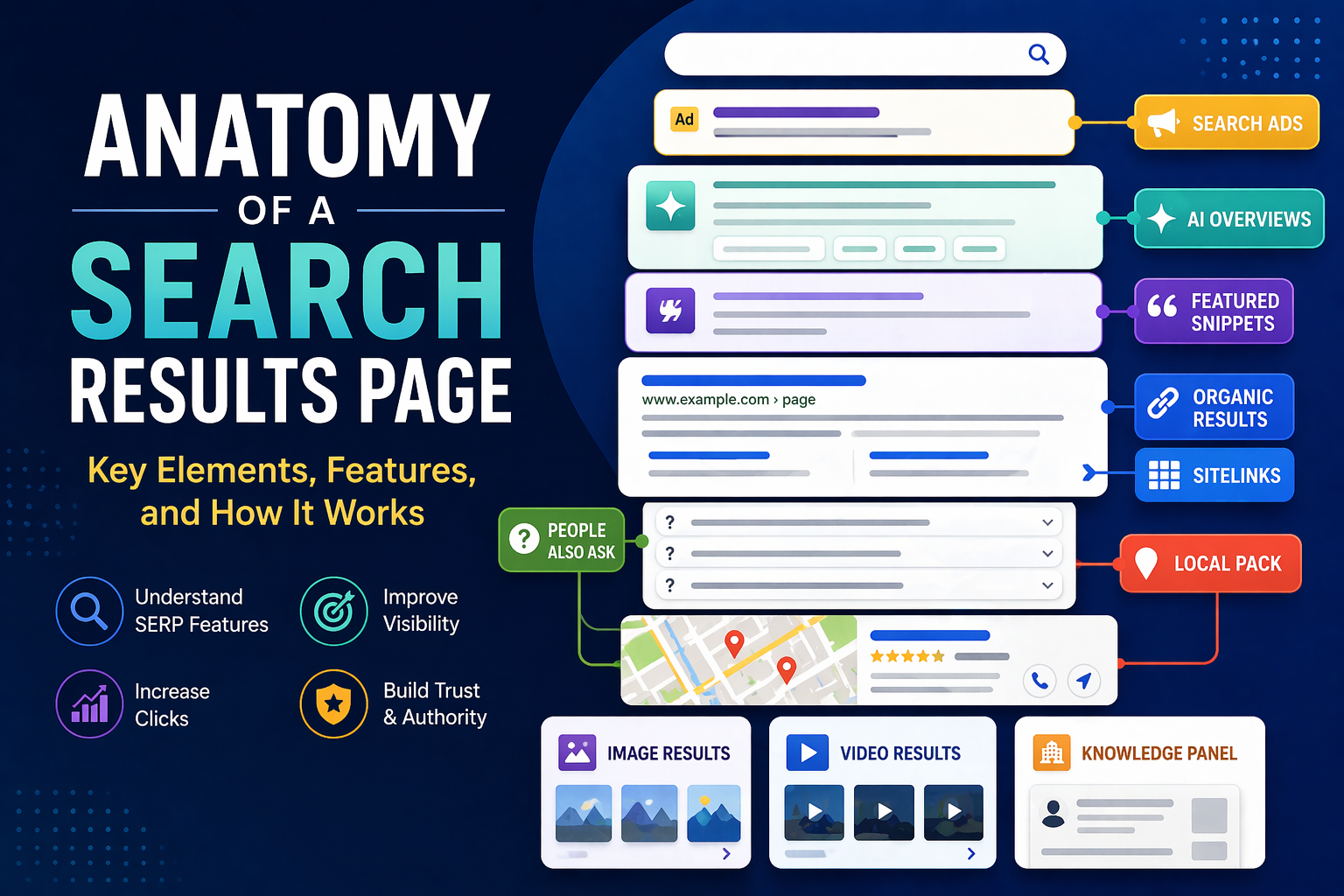
Estimated reading time: 10 minutes
A search results page is no longer just a list of blue links.
Today, a single Google search can show ads, AI summaries, organic listings, featured snippets, map packs, image blocks, videos, and brand panels. Because of that, ranking alone does not tell the full story anymore.
That is why understanding the anatomy of a search results page matters.
If you want to improve SEO, you need to understand what users actually see. You also need to understand what appears above your result, around your result, and sometimes instead of your result.
This guide breaks down the main parts of a modern search results page in a simpler, WordPress-friendly format. It also explains why SERP structure matters for clicks, brand trust, and online reputation. If negative or misleading search results are hurting your brand, Remove Online Information offers content removal and search-result cleanup solutions that can help improve your visibility.
What Is a Search Results Page?
A search results page, or SERP, is the page Google shows after someone searches for something.
Its purpose is simple. It tries to give the user the best answer.
However, the way that answer appears depends on the query.
For example:
- A local search may show a map pack
- A question may show a featured snippet
- A broad topic may show an AI Overview
- A product search may show ads
- A brand search may show sitelinks and a knowledge panel
So, there is no single fixed SERP layout.
Instead, the page changes based on search intent.
Why SERP Anatomy Matters
SERP anatomy matters because visibility is no longer based on rankings alone.
A page can rank well and still lose clicks if:
- ads appear above it
- a featured snippet takes the attention
- an AI Overview answers the question first
- a local pack dominates the page
- video or image blocks push it lower
In other words, position is only part of the picture.
The full page layout affects:
- click-through rate
- brand trust
- user behavior
- traffic potential
- reputation
That is why SEO today requires more than tracking rank.
You need to study the full page.
The Main Parts of a Search Results Page
A modern search results page may include many features.
The most common ones are:
- Search ads
- AI Overviews
- Organic results
- Featured snippets
- Sitelinks
- Rich results
- People Also Ask
- Local pack
- Image results
- Video results
- Knowledge panels
Not every search shows all of them. Still, these are the main elements that shape a modern SERP.
1. Search Ads
Search ads are paid listings.
They usually appear at the top or bottom of the page. They are marked as sponsored results.
Why ads matter
Ads often take the first visible positions.
That means users may click a paid listing before they even see the first organic result.
This is common for searches with buying intent, such as:
- best CRM software
- buy running shoes
- divorce lawyer near me
- web design agency
What this means for SEO
Even if your page ranks organically, ads may still get the first clicks.
As a result, a strong ranking does not always guarantee strong traffic.
2. AI Overviews
AI Overviews are one of the biggest changes in today’s SERP layout.
These are AI-generated summaries that may appear for some searches.
They are designed to give users a quick answer and often include supporting links.
What AI Overviews usually do
They often:
- summarize the topic
- answer broad questions
- give quick context
- show source links
- suggest follow-up exploration
Why they matter
They change how users interact with the page.
Instead of scanning standard listings first, users may read the summary first.
That means attention is now being divided differently across the SERP.
3. Organic Results
Organic results are the unpaid listings ranked by Google.
These are still one of the most important parts of the search results page.
A standard organic result usually includes:
- a title link
- a visible URL or breadcrumb
- snippet text
- a site name
- sometimes extra enhancements
Why organic results still matter
Organic results still matter because they:
- drive long-term traffic
- build authority
- support content visibility
- help users compare sources
- strengthen brand awareness
However, organic listings now compete inside a more crowded page.
That means being visible is no longer only about being high in rank.
4. Featured Snippets
Featured snippets are highlighted answers that appear near the top of some SERPs.
They usually answer a question directly.
Common featured snippet formats
Featured snippets often appear as:
- a short paragraph
- a bullet list
- a numbered list
- a table
Why they matter
They can place a page above regular organic results.
They also make the source look authoritative.
Queries that often trigger them
Featured snippets often appear for:
- what is
- how to
- why does
- steps to
- difference between
If your content answers a question clearly, you may have a better chance of appearing here.
5. Sitelinks
Sitelinks are extra links shown below a main search result.
They help users jump directly to important pages on a site.
Why sitelinks matter
Sitelinks help because they:
- take up more SERP space
- improve visibility
- guide users faster
- make a brand look more established
When sitelinks appear
Sitelinks often show up for:
- brand names
- business names
- known websites
- navigational searches
For reputation and brand trust, sitelinks are valuable because they strengthen control over branded search pages.
6. Rich Results
Rich results are enhanced listings.
They include more detail than a standard result.
Common rich-result examples
These may include:
- star ratings
- review counts
- product information
- event details
- recipe details
- article enhancements
Why rich results matter
They make a listing more noticeable.
If two pages rank close together, the richer-looking result may win more clicks.
Important note
Structured data can make a page eligible for rich results. However, it does not guarantee Google will show them.
7. People Also Ask
People Also Ask, or PAA, is the expandable box of related questions.
Each question opens to reveal a short answer and a source.
Why it matters
PAA helps users explore related questions without leaving the SERP.
It also helps content creators understand:
- what users ask next
- what subtopics matter
- how search intent expands around a topic
That makes it useful for both SEO and content planning.
8. Local Pack
The local pack is the map-based section that appears for local searches.
It usually includes:
- a map
- business names
- ratings
- hours
- addresses
- quick action buttons
Searches that often trigger the local pack
Examples include:
- dentist near me
- best coffee shop in Orlando
- emergency plumber nearby
- roofing company Austin
Why it matters
For local-intent searches, the local pack often appears before standard organic results.
That means local SEO can be just as important as traditional SEO.
9. Image Results
Image results appear when visuals help answer the query.
These may appear in a small image pack or mixed into the page.
Queries that often trigger image results
These include:
- products
- food
- places
- people
- design ideas
- visual examples
Why image results matter
Images can:
- catch attention quickly
- improve brand visibility
- support visual trust
- drive extra traffic
If your industry depends on visuals, image SEO becomes part of your SERP strategy.
10. Video Results
Video results appear when users may prefer a visual explanation.
These often show in carousels or mixed web results.
Searches that often show videos
These include:
- tutorials
- reviews
- walkthroughs
- demonstrations
- step-by-step guides
Why they matter
Video can attract clicks differently than text.
For some topics, users want to watch instead of read.
That makes video an important visibility layer for many brands.
11. Knowledge Panels
Knowledge panels appear for entities Google recognizes.
That can include:
- businesses
- brands
- people
- places
- organizations
What a knowledge panel may include
A knowledge panel may show:
- name
- description
- website
- social links
- images
- contact details
- related entities
Why it matters
Knowledge panels shape first impressions.
A strong panel can reinforce legitimacy. A missing or weak panel can reduce trust.
This matters even more for branded searches.
12. Title Links and Snippets
Some of the most important SERP elements are also the smallest.
These include:
- the title link
- the snippet
- the site name
- the visible URL
Why they matter
Even if you do not win a major SERP feature, users still decide whether to click based on these details.
A weak title can lose clicks.
A vague snippet can reduce interest.
A messy-looking result can lower trust.
So, these smaller elements still do a lot of the heavy lifting.
How Search Intent Changes the SERP
Not every keyword gets the same page layout.
That is because search engines change the page based on user intent.
Common intent types
The main types are:
- informational
- navigational
- transactional
- local
- commercial investigation
How intent changes the page
An informational search may show:
- AI Overview
- featured snippet
- People Also Ask
- blog articles
- videos
A local search may show:
- local pack
- map
- reviews
- nearby businesses
A transactional search may show:
- ads
- product features
- category pages
- shopping-style results
A branded search may show:
- homepage result
- sitelinks
- knowledge panel
- social profiles
That is why you should always look at the actual SERP before creating content.
Why SERP Anatomy Matters for Online Reputation
SERP anatomy affects more than clicks.
It also affects trust.
When someone searches your brand, the page they see becomes part of your public image.
If they see:
- a strong homepage
- clear sitelinks
- positive review signals
- accurate profiles
that creates one impression.
If they see:
- negative articles
- complaint pages
- outdated profiles
- harmful discussions
that creates another.
This is where SEO and reputation management connect.
If harmful results are dominating your branded search page, Remove Online Information can help with content removal and online reputation repair.
How to Improve Visibility Across SERP Features
You cannot control every SERP feature. However, you can improve your chances of appearing strongly across the page.
Practical ways to improve SERP visibility
- Match content to search intent
- Answer questions clearly
- Write stronger title links
- Improve snippets
- Add structured data when relevant
- Optimize branded search presence
- Improve local profiles
- Use images and video where helpful
- Keep listings accurate
- Monitor real SERP layouts for your keywords
Important mindset shift
Do not optimize only for rank.
Also optimize for:
- click appeal
- SERP visibility
- trust signals
- branded control
- rich-result eligibility
That is how modern SEO becomes more complete.
Common mistakes people make with SERPs
Many people still approach search results with an old mindset.
Common mistakes include
- focusing only on ranking
- ignoring ads and AI features
- treating all keywords the same
- ignoring branded search
- forgetting rich-result opportunities
- overlooking reputation signals
Once you understand SERP anatomy, these mistakes become easier to avoid.
FAQ: Anatomy of a Search Results Page
It refers to the different visible parts of a SERP, such as ads, AI Overviews, organic results, featured snippets, local packs, and knowledge panels.
The main elements often include ads, organic listings, AI Overviews, featured snippets, People Also Ask, rich results, local packs, images, videos, sitelinks, and knowledge panels.
Paid results are advertisements. Organic results are unpaid listings ranked by search systems.
A featured snippet is a highlighted answer shown near the top of the page when a search engine believes a page answers the question directly.
Rich results are enhanced listings that may show extra details such as ratings, review counts, or product information.
A local pack usually appears when the search has local intent, such as looking for a nearby business or service.
An AI Overview is an AI-generated summary that may appear for some searches to help users understand a topic quickly.
If harmful or misleading results are taking over your branded search page, Remove Online Information can help with search cleanup and content removal.
The anatomy of a search results page is more than a technical SEO topic. It is a visibility framework, a trust signal, and often the first place people judge your brand. If you want stronger control over how your business appears in search, visit Remove Online Information, explore its solutions, or learn more about online reputation repair.
Works Cited
Google. “AI features and your website.” Google Search Central, https://developers.google.com/search/docs/appearance. Accessed 21 Apr. 2026.
Google. “Featured Snippets and Your Website.” Google Search Central, https://developers.google.com/search/docs/appearance/featured-snippets. Accessed 21 Apr. 2026.
Google. “Find information in faster & easier ways with AI Overviews in Google Search.” Google Search Help, https://support.google.com/websearch/answer/14901683. Accessed 21 Apr. 2026.
Google. “How Google’s featured snippets work.” Google Search Help, https://support.google.com/websearch/answer/9351707. Accessed 21 Apr. 2026.
Google. “How to Write Meta Descriptions.” Google Search Central, https://developers.google.com/search/docs/appearance/snippet. Accessed 21 Apr. 2026.
Google. “Learn About What Sitelinks Are.” Google Search Central, https://developers.google.com/search/docs/appearance/sitelinks. Accessed 21 Apr. 2026.
Google. “Structured Data Markup that Google Search Supports.” Google Search Central, https://developers.google.com/search/docs/appearance/structured-data/search-gallery. Accessed 21 Apr. 2026.
Google. “Show ads on the Google search results page.” Google Ads Help, https://support.google.com/google-ads/answer/6238024. Accessed 21 Apr. 2026.
Remove Online Information. “Online Presence Management Solutions.” RemoveOnlineInformation.com, https://removeonlineinformation.com/solutions/. Accessed 21 Apr. 2026.
Remove Online Information. “Online Reputation Repair.” RemoveOnlineInformation.com, https://removeonlineinformation.com/reputation-repair/. Accessed 21 Apr. 2026.
Need help removing something?
Remove Online Information can review your links and explain what is removable, which approach fits, and what it costs, before you commit. Get a free removal assessment or browse our free opt-out guides.