
Home / Solutions / Mugshot removal
Mugshot & arrest record removal
Mugshot Removal Service: Remove Your Mugshot From the Internet & Google
Remove Online Information finds every website showing your booking photo, requests removal at the source, and clears what is left from Google and Bing, so an old arrest stops being the first thing people see when they search your name.
- Free, confidential review of every site showing your mugshot
- Help with dropped, dismissed, sealed, and expunged cases
- Source removal plus Google and Bing clean-up
- Clear options and costs explained before any work begins
Reviewed by the Remove Online Information removal team · Updated October 2026
What to send us
- The exact links (URLs) where your mugshot appears
- The search terms that bring it up, such as your name and city
- How your case ended (dropped, dismissed, sealed, expunged, or pending)
Free, confidential assessment. Do not include passwords, ID numbers, or intimate images in your first message.
Free assessment
Get your mugshot removal options
Send us the links to each mugshot listing, or just your name and the city of the arrest. We search Google, Google Images, and Bing for every copy, check how each website handles removal, and tell you what can come down, how, and what it will cost before you commit to anything.
Request a free assessment
Share the links or search terms. Do not include passwords, ID numbers, or intimate images.

Prefer to talk? Call (855) 581-5827.
The short answer
Can you remove a mugshot from the internet?
- What gets removedBooking photos and arrest listings on mugshot sites, crime blogs, and search results
- Main methodsSource removal, state-law requests, Google and Bing removal tools, suppression
- Strongest casesDropped, dismissed, acquitted, sealed, or expunged charges, and inaccurate listings
- State lawsGeorgia, Florida, Illinois, California, Oregon, Utah, Colorado, and other states restrict pay-to-remove sites
- Typical timingA few days to several weeks per site; Google updates after the source changes
- Does it erase the record?No. Court and police records only change through expungement or sealing
The basics
What is mugshot removal?
Mugshot removal is the process of getting a booking photo and the arrest details attached to it taken down from mugshot websites, arrest-listing sites, local crime pages, and search engines such as Google and Bing. It reduces how easily an arrest shows up when someone searches your name. It does not change the official record kept by the court or the arresting agency.
Mugshots spread because booking data is public in many places. Sheriff and jail websites post booking photos, and commercial sites copy that data automatically, attach your name, age, and charges, and publish it on pages built to rank for your name. One arrest can end up on a dozen or more websites within days, and each copy has its own owner, its own rules, and its own removal process. That is why a real mugshot removal plan works URL by URL, not with a single form.
| Mugshot removal can | Mugshot removal cannot |
|---|---|
| Take down booking photos and arrest listings on commercial mugshot websites | Erase or seal your official arrest, police, or court record |
| Remove outdated results and cached images from Google and Bing | Stop background check companies from seeing court data that is still public |
| Use state laws that ban pay-to-remove practices | Force every news outlet to delete accurate reporting |
| Push remaining results down with positive content when removal is not possible | Guarantee a site that is offline or anonymous will respond |
Where mugshots show up
- Commercial mugshot and arrest-listing websites
- County sheriff and jail booking pages
- Local “busted” newspapers and crime blogs
- Court case and docket sites that list the charges
- Google Images, search snippets, and AI search answers
- Social media pages that repost arrests
What makes a removal request stronger
- Proof the charges were dropped, dismissed, or reduced
- An acquittal, or an expungement or sealing order
- Evidence the listing is inaccurate or outdated
- A state law that limits pay-for-removal practices
- Google’s policy on sites that charge for removal
Sites we cover
Mugshot websites we remove listings from
Commercial mugshot sites change names and domains often, but they fall into a few types. Each type has a different best route to removal.
| Where the mugshot appears | Typical removal route | Notes |
|---|---|---|
| Commercial mugshot and arrest-listing sites | Opt-out form, written request, or state-law demand | Most respond to a complete request. Fee demands are illegal in several states. |
| Sheriff, jail, and police booking pages | Request to the agency; often removed automatically after a set period | Policies vary by county. Some states limit posting of booking photos. |
| Local crime blogs and “busted” papers | Editor or site-owner request | Dismissed or expunged cases are the strongest. |
| News articles about the arrest | Update, anonymization, or news article removal request | Accurate reporting is the hardest to remove; updates are common. |
| Court and docket sites | Removal, anonymization, or noindex request | See our court record removal guide. |
| Background check and people-search sites | Opt-out request | See background check removal. |
| Google and Bing results | Outdated-content, cache, and policy-based removal requests | Works best after the source page changes. |
Step-by-step guides for common mugshot sites
We publish free removal guides for many arrest-listing websites. If you would rather not handle it yourself, request a free assessment.
Do not see your site? We handle many others, including smaller regional arrest sites and newer copycat domains. Browse all of our free opt-out guides or send us the link.
Why it matters
Why an online mugshot does so much damage
A mugshot is built to be judged at a glance. Most people who find one never read further to learn that the charges were dropped or the case was dismissed. Mugshot pages also rank well for names, so the photo often sits on page one of Google, in Google Images, and in the preview cards people see on their phones.
- Hiring and promotions. Employers and recruiters search candidates’ names, even when a formal background check would not show a dismissed charge.
- Housing. Landlords and property managers search applicants online.
- Dating and personal life. New contacts, neighbors, and family members search names too.
- Business and clients. Customers check owners and professionals before they buy. See our reputation repair options.
- Background checks. Some background check sites repeat arrest data; see removing criminal history from background check sites.
- AI answers. AI search tools summarize what ranks for a name, so a mugshot page can end up in an AI-written answer about you.
- Copies multiply. Scraper sites copy each other, so one ignored listing can become several more.
How we remove mugshots
How we get mugshots removed from websites and Google
Every listing gets the route most likely to work for that site. Most cases use more than one.
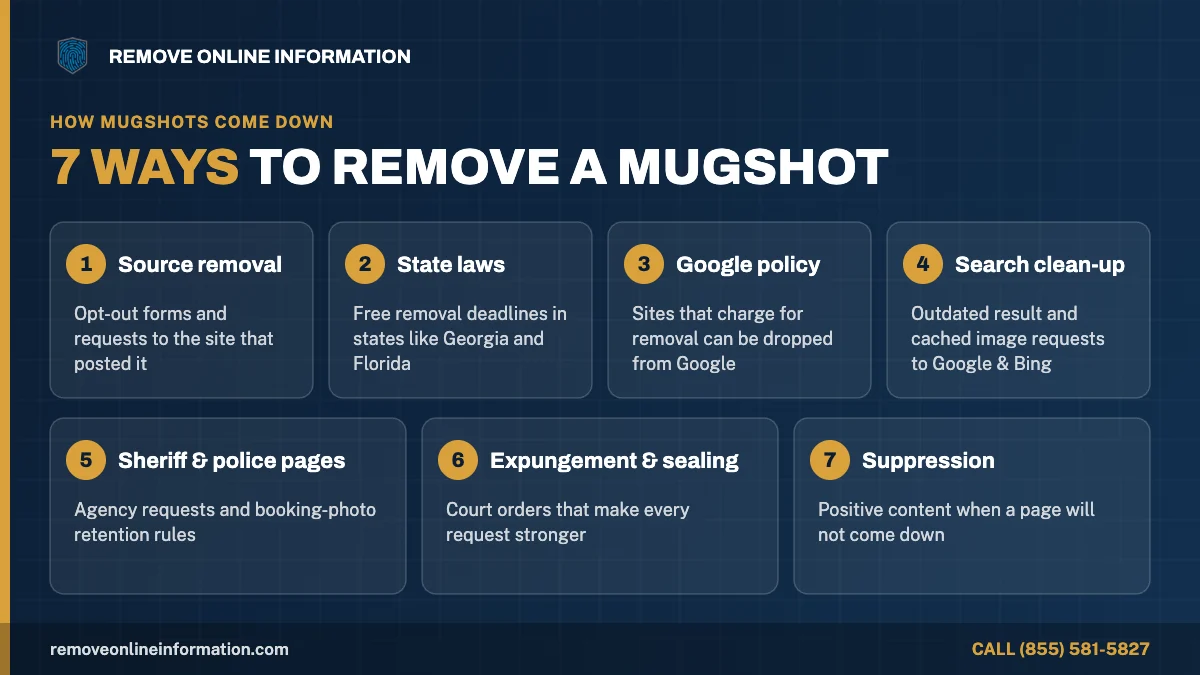
1. Source removal from the mugshot website
The most lasting fix is getting the page itself taken down. We identify each site’s removal process, whether it is an opt-out form, an editor contact, a registered agent, or the hosting provider, and submit a complete request with the details and documents the site needs. When the page is gone at the source, it cannot come back in search results.
2. State-law removal requests
Several states require mugshot sites to remove booking photos for free, and some set hard deadlines. Georgia requires removal within 30 days of a qualifying written request, and Florida requires removal within 10 calendar days of a written request sent to the site’s registered agent. Where a law applies, we build the request around it.
3. Google’s policy for sites that charge for removal
Google will consider removing results about you from websites that demand payment to take content down. If a mugshot site asks for money, that page may qualify for removal from Google Search even if the site itself refuses to act.
4. Outdated result and cached image removal
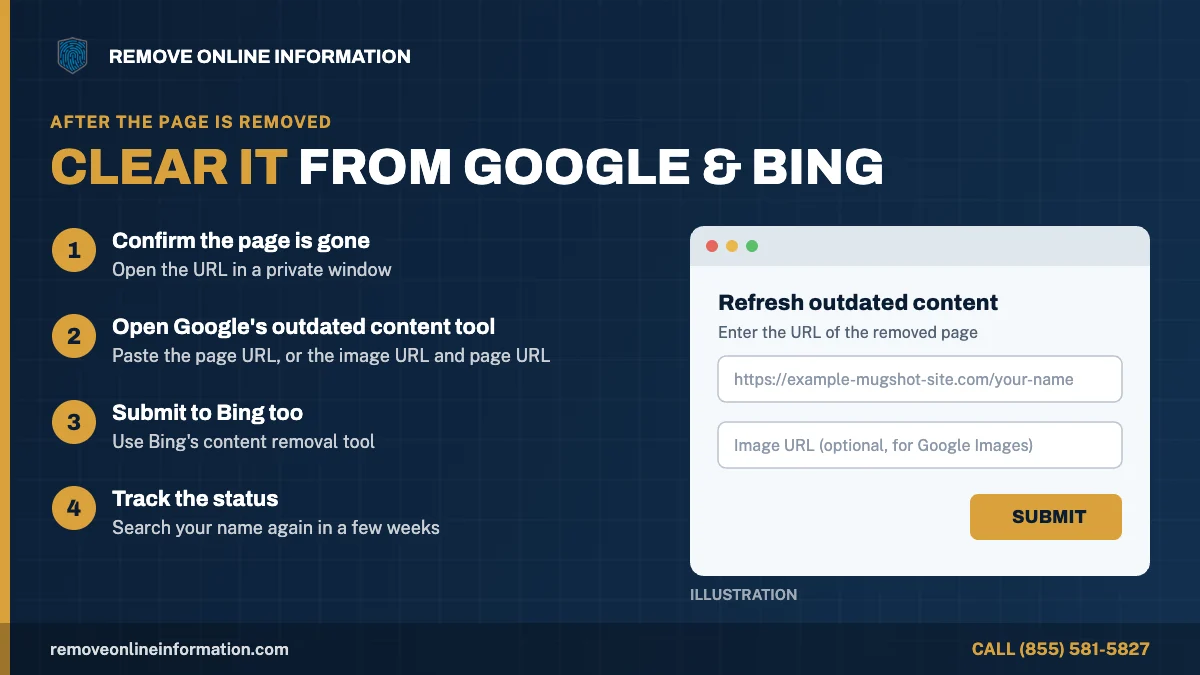
After a page is removed or changed, Google and Bing can still show the old title, snippet, or thumbnail for a while. We submit outdated-content and cache requests to Google and Bing so the result and image clear faster. Our guide to the webpage removal request tool explains how it works, and our Google Image removal guide covers thumbnails.
5. Sheriff and police booking pages
Many counties remove booking photos after a set period or on request, and California limits when police can post booking photos on social media and how long they can stay up. We contact the agency or its records office when the original booking page is the problem.
6. Expungement and sealing support
An expungement or sealing order is one of the strongest documents you can attach to a removal request. We are not a law firm, so we work alongside your attorney, or point you to legal help, when court relief is the right next step. Then we use the order to clear the copies online. See public record removal.
7. Suppression when removal is not possible
Some pages, such as accurate news reports, may not come down. In those cases, search result suppression builds and promotes positive, accurate pages about you so the mugshot moves off the first page. Learn more about dealing with negative Google results.
Our process
How mugshot removal works, step by step
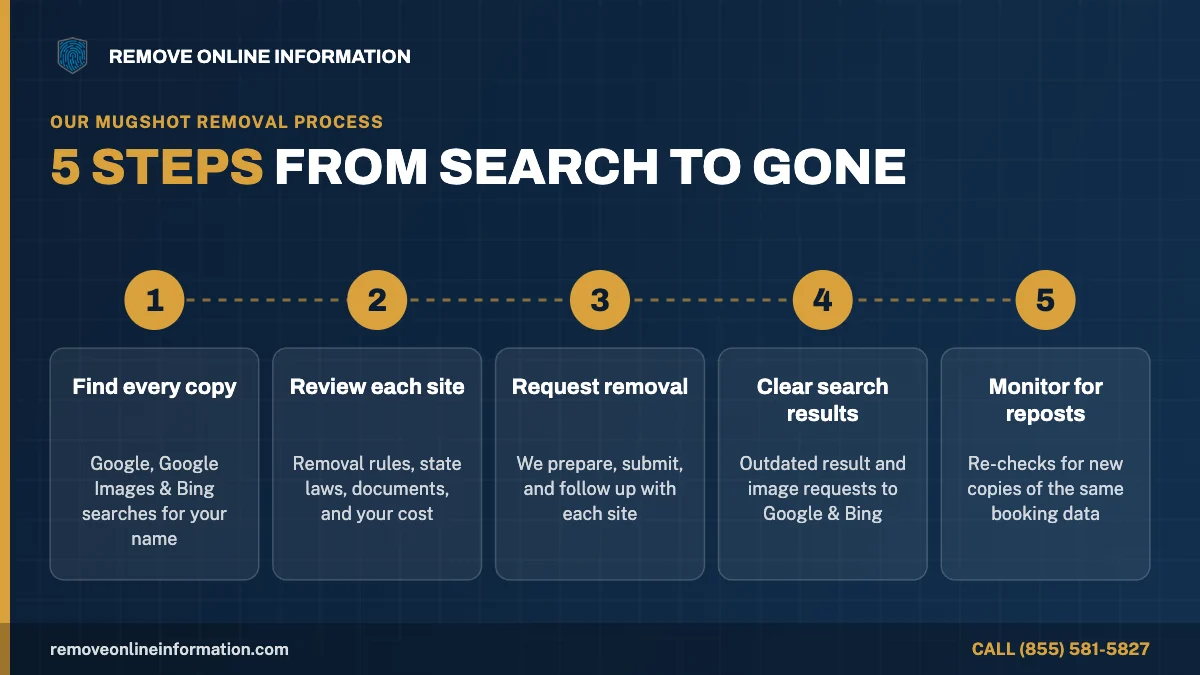
- Find every copyWe search your name, nicknames, and city across Google, Google Images, and Bing, and list each URL that shows your booking photo or arrest details.
- Review each siteWe check how each website handles removal, which state laws apply, and which documents will help, then explain your options and cost.
- Request source removalWe prepare and submit removal requests to each site, with court documents when they help, and follow up until each one is resolved.
- Clear search resultsOnce pages are gone or changed, we request removal of outdated results and cached images from Google and Bing.
- Monitor for repostsWe re-check your name for new copies, since booking data is often scraped and republished by other sites.
Timing
How long does mugshot removal take?
Timing depends on the site, the state, and whether the search engines have refreshed. These are typical ranges, not guarantees.
| Step | Typical timing | What affects it |
|---|---|---|
| Finding every copy | 1 to 2 days | Common names and multiple arrests take longer |
| Mugshot site opt-out or request | A few days to a few weeks | Site responsiveness and documents required |
| Florida state-law request | Up to 10 calendar days after the written request | Request must go to the registered agent with proof of identity |
| Georgia state-law request | Up to 30 days after the written request | Case must meet one of the qualifying conditions |
| Google and Bing clean-up | A few days to a few weeks after the source changes | Crawl timing and cached images |
| Sheriff or police page | Varies by agency | Local retention policy and records requests |
State deadlines are summarized from Fla. Stat. § 901.43 and O.C.G.A. § 10-1-393.5; Oregon (ORS 133.875) and Utah (Utah Code § 17-22-30) set 30-day deadlines, or 7 days for cleared cases. This is general information, not legal advice.
Mugshot laws
State laws that limit pay-to-remove mugshot sites
A number of states regulate mugshot websites. The rules differ on who qualifies, how to send the request, and what the site must do.
| State | Law | What it requires |
|---|---|---|
| Georgia | O.C.G.A. § 10-1-393.5 | Mugshot sites must remove a booking photo free of charge within 30 days of a qualifying written request, such as a dismissed, restricted, or acquitted case. |
| Florida | Fla. Stat. § 901.43 | Sites that publish booking photos may not charge for removal and must remove the photo within 10 calendar days of a written request sent by registered mail to the registered agent. |
| Illinois | 815 ILCS 505/2QQQ | Publishers of criminal record information may not charge a fee to remove or correct it. |
| Texas | Bus. & Com. Code ch. 109 | Covers businesses that charge to remove criminal record information. They must correct inaccurate records free of charge after a dispute, and may not publish records they know have been expunged or placed under an order of nondisclosure. |
| California | Civil Code § 1798.91.1; Penal Code § 13665 | Unlawful to solicit, require, or accept a fee to remove or not publish a booking photo. Police generally may not post booking photos for nonviolent arrests on social media, and most posted booking photos must come down within 14 days. |
| Oregon | ORS 133.875 | Sites that charge for removal must take a booking photo down within 30 days of a request and may charge no more than $50. Removal is free and due within 7 days, with proof, if the case ended in acquittal or no prosecution or the conviction was set aside, vacated, or pardoned. |
| Utah | Utah Code § 17-22-30 | Sheriffs may not release booking photos to pay-for-removal sites. Those sites must remove a photo within 30 days of a request for no more than $50, or within 7 days at no charge if the charge ended in acquittal or non-prosecution or was expunged, vacated, or pardoned. |
| Colorado | C.R.S. § 24-72-305.5 | It is a misdemeanor to obtain a booking photo for a publication or website that charges a fee to remove it. |
| Other states | Varies | Other states also regulate mugshot websites or limit when police release booking photos. Check the current law in your state. |
Laws change, and each statute has conditions and exceptions. This summary is general information, not legal advice. For advice about your case, talk with a licensed attorney in your state.
Why requests fail
Why mugshot sites refuse removal, and what changes their answer
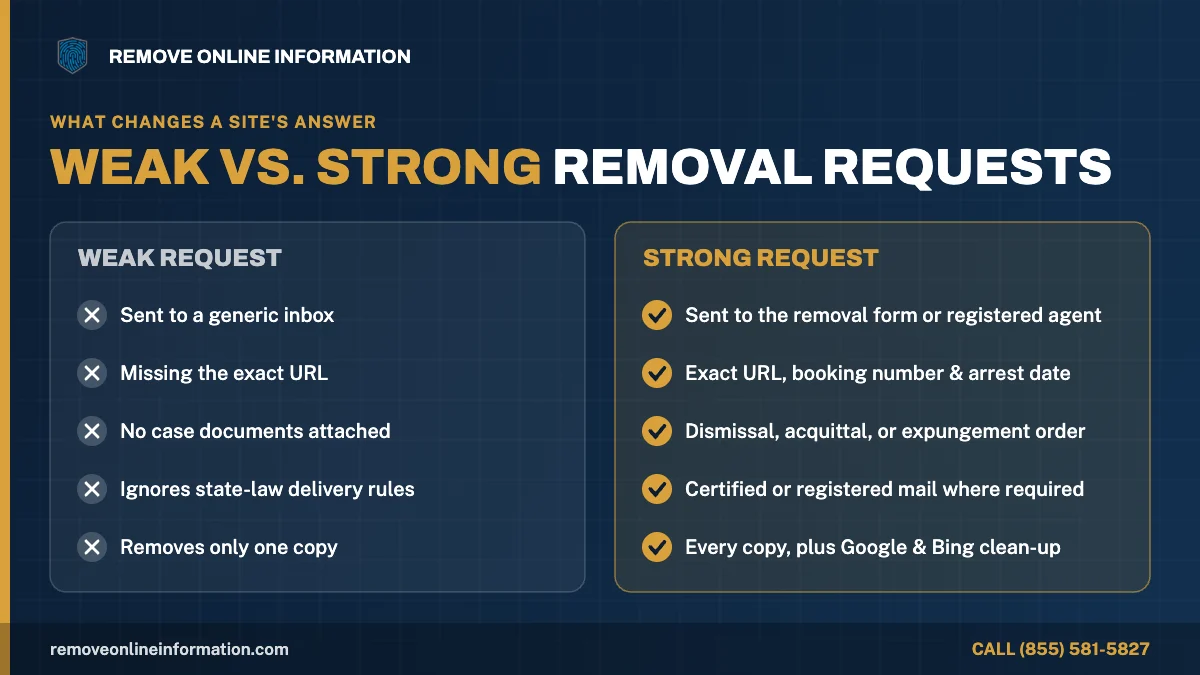
Most refusals come from incomplete or poorly targeted requests, not from sites that will never act. Common reasons a request goes nowhere:
- The request went to a generic inbox instead of the site’s removal process or registered agent
- It did not include the exact URL, booking number, or arrest date
- The case outcome was not documented
- It skipped the delivery method a state law requires
- The site has changed domains and the old contact no longer works
- It removed one copy while others kept ranking
Do it yourself
How to remove a mugshot from the internet for free
You can request many removals yourself at no cost. Here is the process we use, step by step.
- Search for every copySearch your full name in quotes with your city and state in Google, Google Images, and Bing. Try nicknames and middle initials. Save every URL that shows your photo or arrest details.
- Gather your documentsCollect the case disposition, dismissal, acquittal, expungement, or sealing order from the court clerk, plus your booking number and arrest date.
- Find each site’s removal processLook for an opt-out form, “remove a record” link, contact page, or privacy policy. Our free opt-out guides cover many sites.
- Send a complete requestInclude the exact URL, your name as listed, the arrest date, and your documents. If a state law applies, follow its delivery rules, such as certified or registered mail.
- Never pay a mugshot site directlyPaying the site that posted you often leads to more fee demands, and several states ban the practice. Report fee demands to Google and your state attorney general.
- Clean up Google and BingOnce a page is removed, submit it to Google’s outdated content tool and Bing’s content removal tool so the old result and thumbnail drop. See our guides to removing yourself from Google and Bing.
- Check again in a few weeksSearch your name again, since new copies and duplicate listings can appear.
DIY vs. working with a removal service
| Doing it yourself | Remove Online Information | |
|---|---|---|
| Cost | Free, apart from postage for legal requests | Free assessment; cost explained before any work |
| Finding every copy | Manual searching | We search Google, Google Images, and Bing for you |
| Requests | You draft, send, and follow up | We prepare, submit, and follow up on each one |
| Search clean-up | You file each Google and Bing request | Included in the process |
| Hard cases | Unclear next step when a site refuses | Escalation, policy requests, or suppression |
| Best for | One or two listings on cooperative sites | Many copies, refusals, fee demands, or urgent needs |
After removal
Will my mugshot come back after it is removed?
A page that is removed at the source usually stays gone. The bigger risk is a different site picking up the same booking data. Mugshot sites scrape public booking pages and each other, so a new copy can appear weeks or months later, especially while the original jail or sheriff listing is still public.
Compare options
Mugshot removal options compared
| Option | What it does | Removes the source page? | Typical cost |
|---|---|---|---|
| Doing nothing | Mugshot stays visible and copies may spread | No | Free, but ongoing harm |
| Do-it-yourself requests | You contact each site and search engine | Often | Free |
| Paying the mugshot site | Site may remove one copy, then others appear | Sometimes | Varies; illegal in several states |
| Removal service | Finds every copy, submits requests, clears search results | Often | Varies by number of sites |
| Expungement or sealing | Changes the official record through the court | No, but strengthens every request | Court and attorney fees vary |
| Search suppression | Pushes results down with positive content | No | Varies |
Why Remove Online Information
Why people choose us for mugshot removal
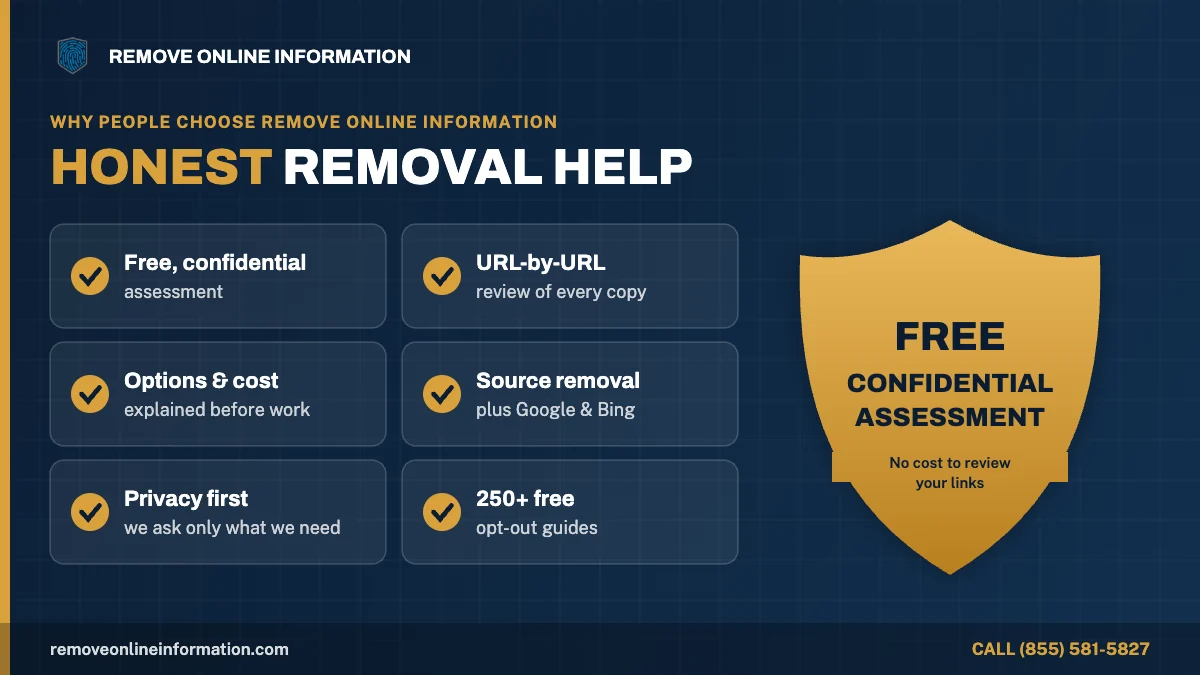
We help people remove personal information, damaging content, and unwanted search results, and we explain every option in plain English before any work begins.
URL by URL, not one-size-fits-all
Every page, website, and search result has its own rules. We assess each one before recommending anything.
Clear about what is possible
We explain the difference between source removal, search removal, and suppression, and we do not promise outcomes no one can control.
Privacy first
We ask only for what we need and keep every inquiry confidential.
Free guides for 250+ sites
Our step-by-step opt-out guides cover people-search, background check, and records websites.
Official resources
Where to report mugshots and fee demands
FAQ
Mugshot removal FAQs
Get started
Get your mugshot off the internet
Send us the links to each mugshot listing, or just your name and city. We will find every copy, review each one, and explain what can be removed before you commit.
Remove Online Information is not a law firm and does not provide legal advice. Information on this page is general and may not apply to your situation. We are not affiliated with Google, Bing, or any website named on this page. Results depend on each website’s and search engine’s policies.