

Home / Opt-out guides / Georgia Gazette
Jail booking & mugshot removal guide
Georgia Gazette Mugshot Removal: How to Remove Your Booking Photo From The Georgia Gazette and Google
Yes, you can get a mugshot removed from The Georgia Gazette, and it should cost you nothing. If your case ended in one of eight outcomes listed in Georgia law (dismissed, nolle prossed, acquitted, restricted and others), mail a written request by certified mail to The Georgia Gazette, LLC, PO Box 340, Richmond Hill, GA 31324, or use its online form with proof. Convictions and pending cases can apply under the site’s Second Chance Policy. Once the page is gone, clear the old result from Google.
The short answer
Can you remove your mugshot from The Georgia Gazette?
In most cases, yes. The Georgia Gazette states on its Removal Request page that it complies with GA Code § 35-1-19 and O.C.G.A. § 10-1-393.5, the Georgia laws that require commercial mugshot publishers to take down a booking photo for free within 30 days when the case ended in a qualifying way. If your case qualifies, removal is a right, not a favor, and you do not need a lawyer or a paid service to ask for it.
If your case ended in a conviction, or is still open, the law does not force the Gazette to remove anything. The site instead runs a voluntary Second Chance Policy: an anonymous committee reviews each request and weighs the charge, how long ago the booking was, the outcome and your criminal history. Approval is discretionary, so this route is a request, not a right.
Either way, removal from the Gazette only fixes the Gazette. Search engines and other mugshot sites may still show your photo, which is why this guide also covers Google, AI answers and copies elsewhere. For the bigger picture on booking photos, see our mugshot removal hub.
Watch for copies. Georgia booking photos are often republished by other sites that pull the same jail data. Removing the Gazette listing does not remove a copy on Busted Newspaper, Mugshots Zone or RecentlyBooked; each one needs its own request.
What is The Georgia Gazette?
The Georgia Gazette (thegeorgiagazette.com) is an online-only publication based in Richmond Hill, Georgia, that brands itself as real, independent news. Alongside written stories about arrests, court cases and sentencings, it runs a large Jail Bookings section built from booking records that sheriffs’ offices release under the Georgia Open Records Act. Its Counties page lists well over 100 Georgia counties, from Cobb and Gwinnett to Chatham and Lowndes, each with its own stream of booking posts.
The site states that it is not affiliated with any government agency and that an arrest does not mean guilt. It also sells premium subscriptions and has mobile apps, which is one reason its pages are indexed and shared widely. If you were booked into a county jail in Georgia, even on a minor misdemeanor or a traffic charge, there is a real chance a Gazette page with your photo exists.
Step by step
How to remove your mugshot from The Georgia Gazette
These steps follow the Gazette’s own Removal Request and Second Chance pages as published in November 2026.
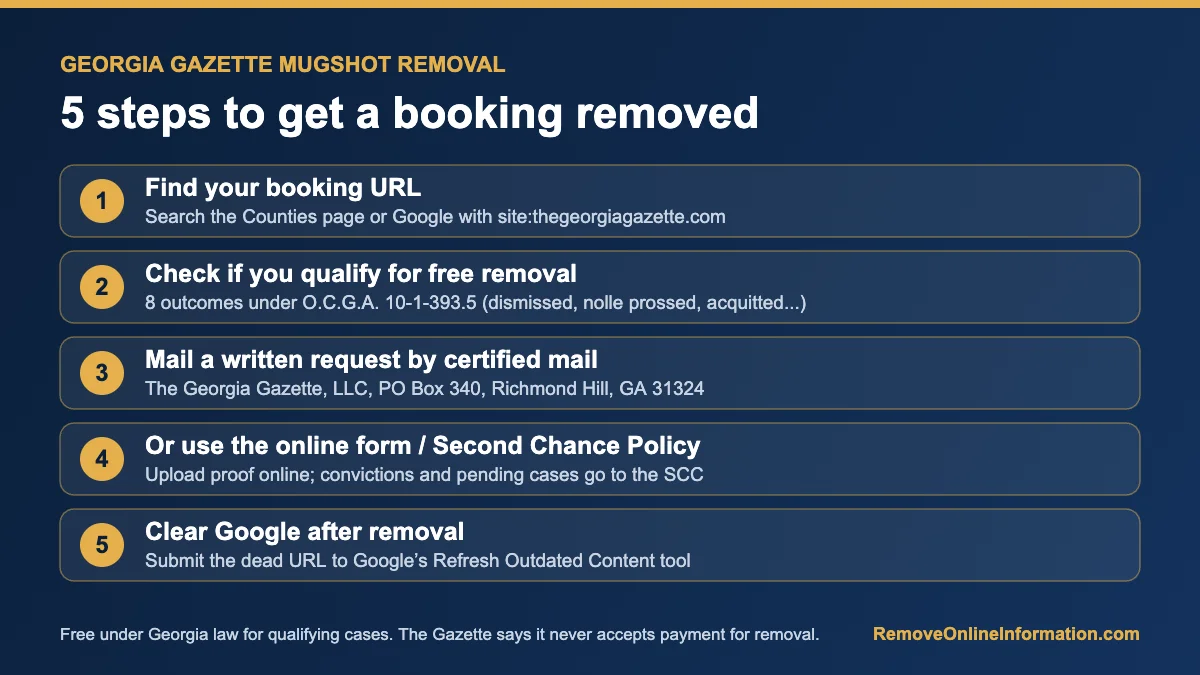
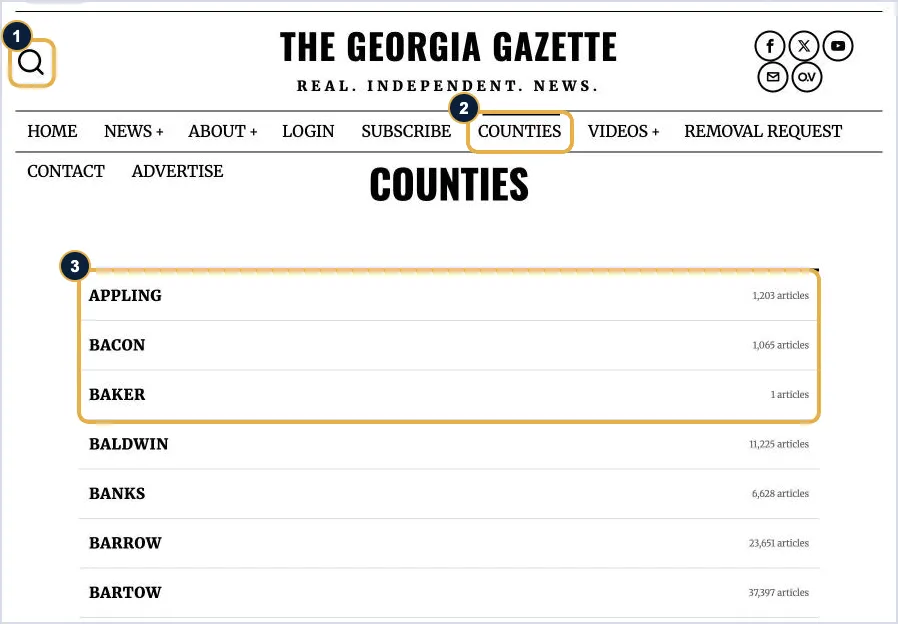
- Find every Gazette URL with your nameSearch Google for site:thegeorgiagazette.com "First Last", then try your middle name, a nickname and a maiden name. On the Gazette itself, open Counties, choose the county where you were booked and use the search icon. Copy the full URL of each booking or story; you may have more than one if you were booked more than once.
- Check whether you qualify for free removalCompare your case with the eight qualifying outcomes listed below (dismissed, nolle prossed, acquitted, record restricted, never referred, statute of limitations expired, two no bills, or completed probation under § 16-13-2 for certain drug possession). If one fits, you are entitled to free removal under Georgia law.
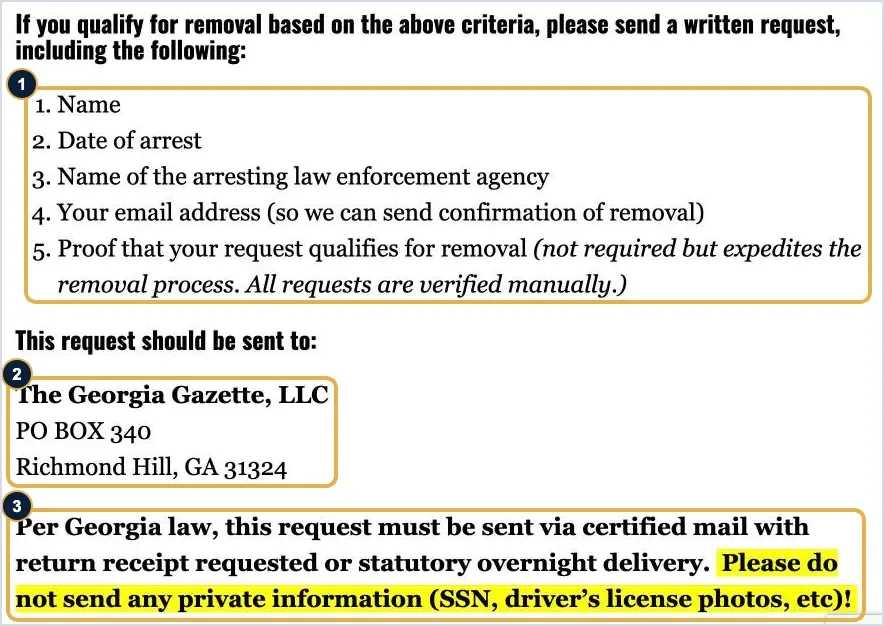
- Gather your case details and proofYou need your full name, date of birth, date of arrest and the name of the arresting agency (for example, the Cobb County Sheriff’s Office). Proof is optional by mail but speeds things up: a certified disposition, dismissal order, nolle prosequi, acquittal, or a GCIC record restriction notice. Black out anything private such as your Social Security number.
- Mail a written request by certified mailSend it by certified mail, return receipt requested, or statutory overnight delivery to The Georgia Gazette, LLC, PO Box 340, Richmond Hill, GA 31324. Include your email so they can confirm removal. Keep the receipt; the 30-day clock under Georgia law starts from your request.
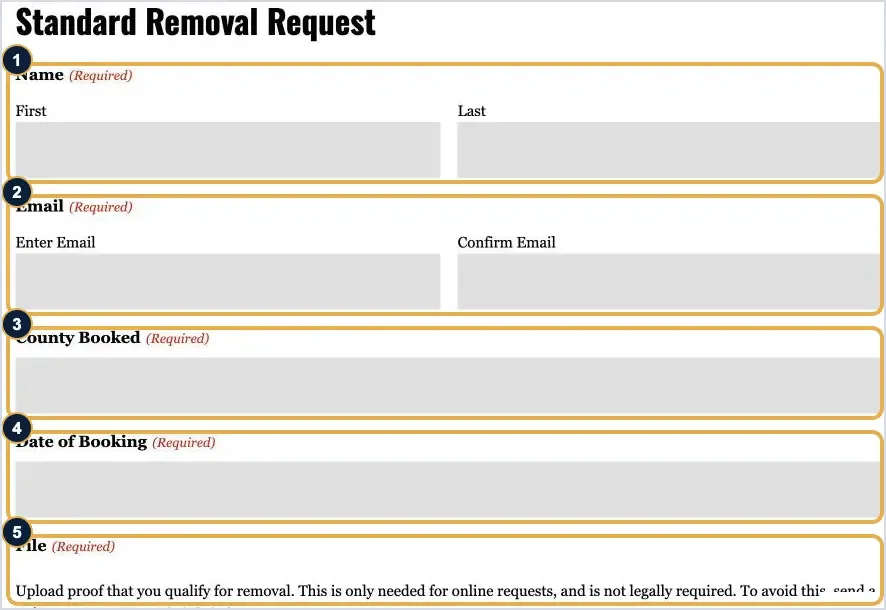
- Or submit the online form with proofIf you have documents, the Standard Removal Request form on the same page asks for your name, email, county booked, date of booking and a required proof upload, plus an optional comment of up to 600 characters. The Gazette calls the form a convenience; the certified letter is the method the law recognizes.
- Use the Second Chance Policy if you were convicted or your case is openSubmit the Second Chance Removal Request form with your name, email, county booked, date of booking and an explanation of up to 1,500 characters of why the information should come down.
- Confirm removal, then clean up Google and copiesWhen the page is gone, request a refresh in Google, check Bing, and run the same name search across other mugshot sites. One request per site is the rule.
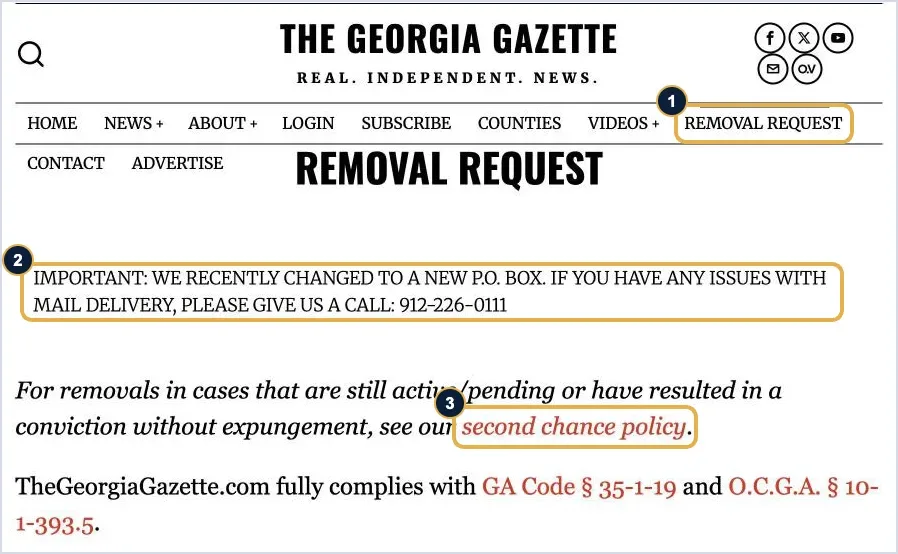
Use the new P.O. box. The Gazette moved to PO Box 340 in Richmond Hill and posts a phone number for mail problems (912-226-0111). Older guides still list a previous box; a letter sent there may be delayed or lost, which can stall your 30-day deadline.
Prefer not to write the letter yourself? The free mugshot removal request letter tool drafts a Georgia removal letter from your case details, and its Georgia mugshot law page summarizes the statute.
Who qualifies
The eight outcomes that make Georgia Gazette removal free
The Gazette quotes the Georgia Department of Law’s Consumer Protection Division. You qualify for free removal if any one of these applies to your booking:
| # | Your case outcome | Proof that helps |
|---|---|---|
| 1 | Access to the case or charges was restricted under O.C.G.A. § 35-3-37 (Georgia record restriction) | GCIC restriction letter or court order |
| 2 | Before any indictment or accusation, the arresting agency never referred the case for prosecution and closed it | Letter or report from the arresting agency |
| 3 | Before any charging document, the statute of limitations ran out | Disposition record showing no charges filed |
| 4 | Before any charging document, the case was referred to the prosecutor and later dismissed | Prosecutor’s dismissal or no-action letter |
| 5 | The grand jury returned two no bills | Clerk’s record of the no bills |
| 6 | After indictment or accusation, all charges were dismissed or nolle prossed | Dismissal order or nolle prosequi |
| 7 | You pleaded guilty or were found guilty of possession of certain drugs, were sentenced under § 16-13-2 and finished probation | Discharge or completion order |
| 8 | You were acquitted of all charges by a judge or jury | Verdict or acquittal order |
Pending cases and convictions are not on the list. A reduced charge does not automatically qualify either; for example, a DUI reduced to reckless driving is still a conviction. Those cases go to the Second Chance Policy. If you are not sure how your case ended, the clerk of court in the county where you were charged can give you a certified disposition, and our public records removal guide explains how court records differ from mugshot pages.
Your request
What to write in a Georgia Gazette removal request
The Gazette verifies every request manually, so a short, specific letter that points to one qualifying category moves fastest. Name the ground, attach the proof, and list every URL.
Dismissed or nolle prossed charges
Say that all charges from the booking were dismissed or nolle prossed after accusation or indictment (category 6), give the court and case number, and attach the order. If only some charges were dropped, you do not meet category 6; the Second Chance route is the better fit.
Never charged or case closed by police
For categories 2 to 5, explain that no charging document was ever filed and how the case ended. A letter from the prosecutor or arresting agency stating that no charges were pursued is the strongest proof here.
Acquittal
State that you were acquitted of all charges by a judge or jury (category 8) and include the verdict form or judgment.
Record restriction (Georgia’s version of expungement)
Georgia does not destroy records; it restricts them. If your arrest was restricted under § 35-3-37, cite category 1 and attach the GCIC notice or court order. For arrests on or after July 1, 2013, restriction generally goes through the prosecutor; for older arrests you apply at the arresting agency.
Completed drug probation under § 16-13-2
Name the statute, the sentence and the date you finished probation (category 7), and attach the discharge order.
Sample removal request
To: The Georgia Gazette, LLC, PO Box 340, Richmond Hill, GA 31324
Sent by certified mail, return receipt requested
I request removal of my booking photograph under O.C.G.A. § 10-1-393.5 and § 35-1-19.
Name: [Full name]Date of birth: [MM/DD/YYYY]Date of arrest: [MM/DD/YYYY]Arresting agency: [e.g., Gwinnett County Sheriff’s Office]Page URL(s): [paste each Gazette URL]Email for confirmation: [email]
Qualifying ground: After accusation, all charges were dismissed (category 6). A copy of the dismissal order is enclosed.
Please remove the photograph and related booking information within 30 days as required by Georgia law and confirm by email.
[Signature, date]
Send copies, never originals, and leave out your Social Security number, driver’s license and anything else the Gazette did not ask for.
Convictions and open cases
The Georgia Gazette Second Chance Policy explained
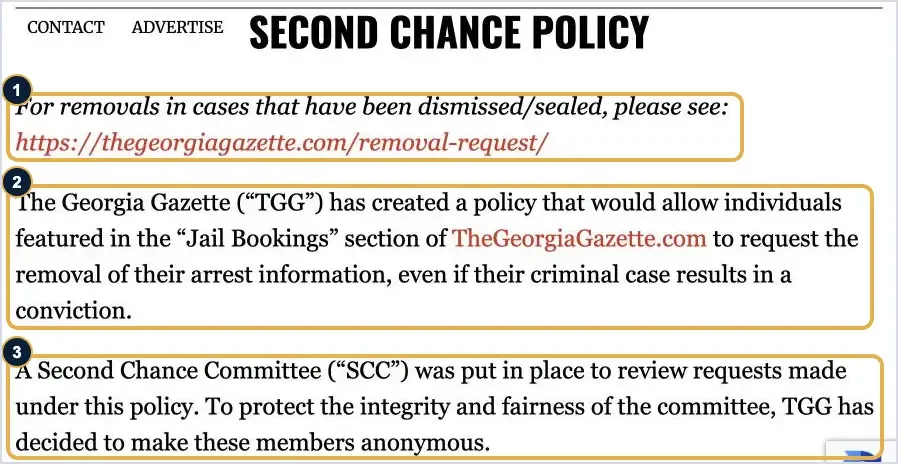
If your case does not fit the eight categories, the Gazette’s Second Chance Policy lets people featured in its Jail Bookings section ask for removal even after a conviction. An anonymous Second Chance Committee (SCC) decides each request.
| Factor the SCC weighs | What the policy says |
|---|---|
| Severity of the charge | Serious and violent charges, especially with a conviction, are more likely to stay public; removal is case by case |
| Time since booking | Most non-violent misdemeanors: at least 1 year since booking. DUI (even if reduced): at least 2 years since arrest. Felonies and violent crimes: at least 2 years, case by case |
| Outcome and sentence | The committee reviews the result, any plea deal and the sentence, and asks for copies of that paperwork |
| Criminal history | Repeat offenders do not qualify |
| Harm vs. public interest | Whether the harm of publication outweighs the public’s right to easy access |
Write your explanation as if a stranger is deciding: what happened, what the court did, what you have done since (completed probation, treatment, steady work, school), and the concrete harm the page causes, such as a lost job offer or a landlord rejection. The form allows 1,500 characters, so be direct. The Gazette says it may deny any request in its sole discretion, may not explain a denial, and can change the policy at any time. It also states that neither the Gazette nor the committee will ever take payment for removal.
If you apply too early, wait until the minimum time has passed rather than sending repeated requests; the Gazette notes that numerous follow-ups can slow things down.
Know the difference
Removal vs. de-indexing vs. record restriction vs. suppression
| Option | What it changes | What it does not change | Who handles it |
|---|---|---|---|
| Gazette removal | Takes the booking page off thegeorgiagazette.com | Copies on other sites; court and police records | The Georgia Gazette, after your request |
| Google refresh or de-indexing | Drops the dead or changed URL from Google results | The page itself, if it is still live | Google, via its Refresh Outdated Content tool or removal policies |
| Record restriction (Georgia “expungement”) | Hides the arrest from GCIC employment-level background checks | Private websites that already copied the photo, until you ask them | Prosecutor, arresting agency and GCIC |
| Court record sealing | Seals court paperwork from public view | Mugshot pages and news stories | A judge, on petition |
| Suppression | Pushes the result down with positive content | The page stays online | You or a reputation firm |
The best order is usually: restrict or seal the record if you are eligible, use that order to get the Gazette page removed, then clear Google and the copy sites. Restriction also strengthens requests to other publishers. For case-law and court-docket sites, see our court case removal guides.
Remove a Georgia Gazette result from Google
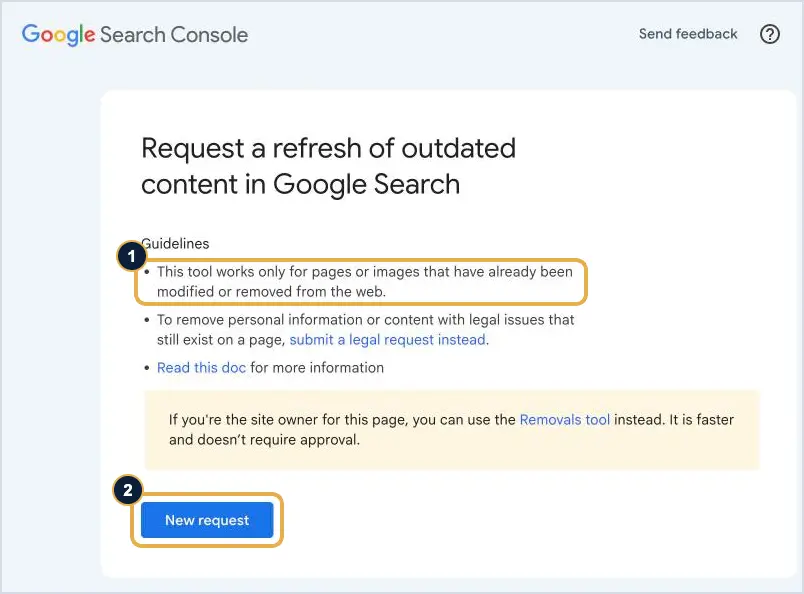
Google does not control the Gazette, so start with the site. Once the page is removed or returns an error, open Google’s Refresh Outdated Content tool, paste the exact Gazette URL and submit. Repeat for the image URL if your photo still shows in Google Images. Do the same in Bing Webmaster Tools’ content removal tool.
If the page is still live because you do not qualify, Google will usually not remove it on request. Google’s personal-content policies target sites that charge for removal, and the Gazette says it never charges, so that route rarely applies here. In that situation the realistic options are the Second Chance Policy, record restriction followed by a new request, or suppression.
Timing
How long Georgia Gazette mugshot removal takes
| Stage | Typical time | Source |
|---|---|---|
| Certified-mail request (qualifying case) | Within 30 days of your request | Georgia law (O.C.G.A. § 10-1-393.5) |
| Online form (qualifying case, with proof) | Gazette says it aims to finish within 30 days of receipt | Gazette Removal Request page |
| Second Chance Policy decision | Not published; case by case | Gazette Second Chance page |
| Minimum wait before Second Chance | 1 year (most misdemeanors), 2 years (DUI, felonies, violent charges) | Gazette Second Chance page |
| Google drops the dead URL after a refresh request | Typically a few days to a few weeks | Typical, not guaranteed |
| AI answers stop repeating it | Weeks or longer; varies by tool | Typical, not guaranteed |
Record the date your certified letter was delivered. If 30 days pass with no removal for a qualifying case, Georgia law treats the failure as a violation of the Fair Business Practices Act, and you can file a complaint with the Georgia Department of Law’s Consumer Protection Division. Note the Gazette’s own caveat that complaints cannot be based on the online form alone, which is another reason to send the letter.
If your request is denied or ignored
- Check the address. Letters to the old P.O. box are the most common reason requests vanish. Resend to PO Box 340 and call 912-226-0111 if mail is a problem.
- Fix missing details. A request without date of birth, arrest date or agency may not be matched to your booking.
- Get the right paperwork. A certified disposition from the clerk beats a screenshot of a court portal.
- Restrict the record first. A GCIC restriction moves you into category 1, which turns a discretionary request into a legal one.
- Wait out the Second Chance clock. Reapply after the 1- or 2-year mark rather than sending repeat follow-ups.
- File a complaint if the law applies. For a qualifying case not removed in 30 days, contact the Consumer Protection Division with your mail receipt.
Your options
DIY vs. RemoveOnlineInformation.com
Most people with a dismissed Georgia case can get a Gazette page removed on their own with one certified letter. Help makes sense when there are several bookings, copies on other sites, a conviction to work around, or no time to chase it.

| Do it yourself | RemoveOnlineInformation.com | |
|---|---|---|
| Cost | Free (plus certified postage) | Free, confidential assessment and a firm quote before any work |
| Georgia Gazette request | You draft, mail and track the letter or form | We prepare the request and track it to removal |
| Second Chance cases | You write the explanation and wait | We help frame the request with your paperwork |
| Copies on other mugshot sites | Find and request each site yourself | We search for copies and request each one |
| Google, Bing and AI answers | Submit refresh requests yourself | We file the refresh requests and re-check results |
| After removal | Re-check your name periodically | Ongoing monitoring and re-removal if a listing comes back |
If you prefer a dedicated mugshot specialist, Remove-Arrests.org handles Georgia arrest and mugshot removal, and Defamation Defenders offers an online mugshot removal service for complex or multi-site cases.
or call (855) 581-5827
FAQ
Georgia Gazette mugshot removal FAQ
Want your Georgia Gazette mugshot handled for you?
We prepare the Gazette request, track it to removal, clean up Google and find copies on other mugshot sites. Start with a free, confidential assessment and a firm quote before any work.
RemoveOnlineInformation.com is not a law firm and this guide is not legal advice. We are not affiliated with The Georgia Gazette, and removing a web page does not alter official court, police or GCIC records. Policy details reflect the Gazette’s published Removal Request and Second Chance pages as of November 2026 and may change.