
Home / Opt-out guides / CrimeWatch
Police arrest post removal guide
CrimeWatch Removal: How to Remove Your Arrest Listing From CrimeWatch and Google
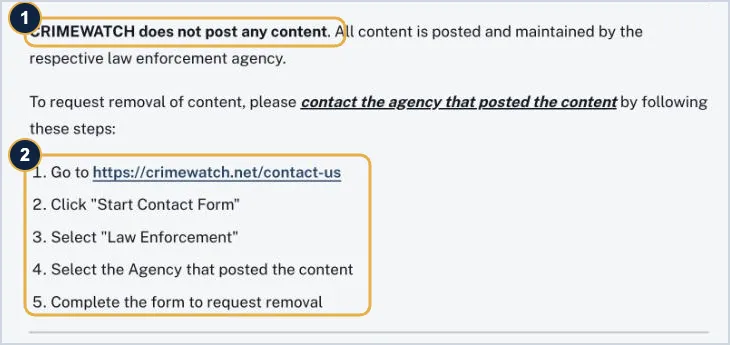
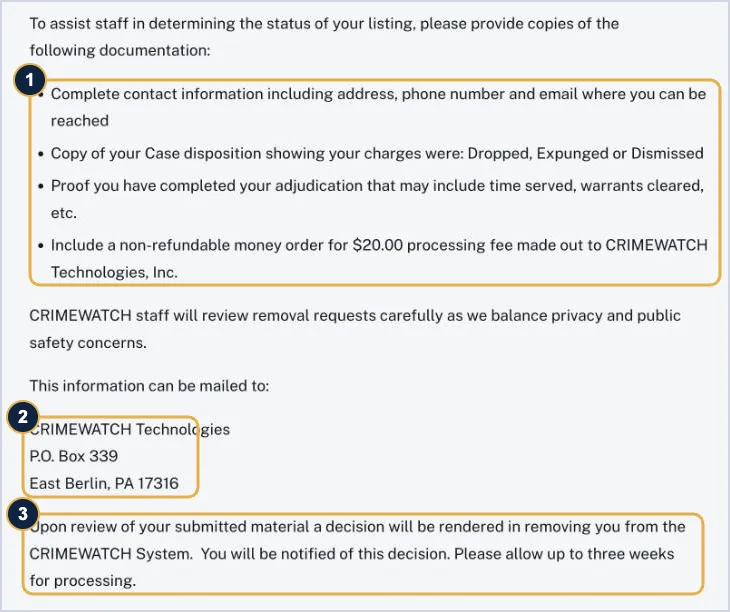
CrimeWatch (crimewatch.net, formerly CrimeWatchPA.com) says it does not post content itself: each arrest, mugshot or press release is posted and maintained by the police department, sheriff or district attorney that uses the platform. To get a listing taken down, ask the agency that posted it through the CrimeWatch contact form, or mail CrimeWatch your court disposition, proof your case is finished and a $20 non-refundable money order. CrimeWatch says to allow up to three weeks. Then ask Google to drop the outdated result.
Quick facts
- Removal routePosting agency (via crimewatch.net/contact-us) or mail to CrimeWatch
- CostAgency route: none published. Mail route: $20 non-refundable money order
- What it doesAgency or CrimeWatch staff decide whether to remove the listing
- Proof asked forDisposition showing charges dropped, dismissed or expunged, plus proof the case is complete
- Multiple postsEach post is separate; list every URL
- Account neededNo
- Attorney neededNo, CrimeWatch says
- Processing timeMail route: up to three weeks (published)
- Last reviewedNovember 2026
Can you remove an arrest post from CrimeWatch?
Often, yes, especially if your charges were dropped, dismissed or expunged. CrimeWatch Technologies runs the software, but it states plainly that it does not post anything: the arrest, booking photo, press release or wanted notice was published by a specific law enforcement agency, and that agency controls it. Its published compliance page gives two routes. You can contact the agency that posted the content through CrimeWatch’s contact form, or you can mail CrimeWatch a short packet with your court paperwork and a $20 money order for staff review. Either way, the decision is made case by case, and CrimeWatch warns that removal may be delayed if the matter is part of an ongoing investigation, a current arrest or an active warrant, or if taking it down would create a public safety risk.
Removal is not automatic, and CrimeWatch does not publish a list of approval rules beyond the documents it asks for. The stronger your paperwork, the better your odds. If you were convicted, a request can still be made, but you are asking for discretion rather than pointing to a clear outcome, so explain your situation carefully.
Check for copies. CrimeWatch portals offer email alerts to local subscribers and share buttons for social media, and police posts are sometimes picked up by local news sites and mugshot aggregators. Taking the CrimeWatch page down does not remove those copies. Search your full name with the town, county and words like arrest or police, and see our mugshot removal hub for the sites that most often republish police posts.
What CrimeWatch is and why your arrest is on it
CrimeWatch is a public safety platform made by CRIMEWATCH Technologies, Inc., a company based in Pennsylvania. Police departments, sheriff’s offices and district attorneys pay for it to run their public websites: each agency gets a portal where it posts press releases, arrests, most wanted and warrant notices, crime alerts and community news. As of November 2026 its homepage claims more than 360 agency relationships across 16 states and roughly half a million active subscribers. The platform started in Pennsylvania, and the old CrimeWatchPA.com address now redirects to the Pennsylvania section of crimewatch.net, so a link you saved from CrimeWatchPA years ago points to the same system.
You are on CrimeWatch because an agency chose to publish your arrest. Some departments post arrests routinely, and the page stays up until the agency or CrimeWatch staff remove it. Arrest posts are indexed by Google, so a CrimeWatch page can rank on the first page for your name long after the case is over. CrimeWatch’s compliance page says CrimeWatch staff and agencies try to balance privacy against public safety, which is why the outcome of the case matters so much.
What a CrimeWatch arrest post usually shows
- Booking photo, when the agency adds one
- Full name, written last name first in the page title
- Each charge with its grade, such as M for misdemeanor or S for summary offense
- Age, sex, race, height, weight, hair and eye color
- Arrest date, a reference ID and the date the post was created
- Town or general location, often with a map
- A short narrative from the agency about the arrest
- Share buttons and the agency’s name, address and phone number
Posts live at addresses like crimewatch.net/us/[state]/[county]/[agency]/[number]/arrests/[your-name-and-charge]. Copy that full URL, because it tells you exactly which agency posted it. CrimeWatch arrest pages carry a noarchive and noimageindex tag, so Google should not keep a cached copy or index the booking photo on its own, but the page itself can appear in search.
How to remove your arrest from CrimeWatch, step by step
These steps follow CrimeWatch’s own published compliance instructions, with the practical details that make a request easier to approve.
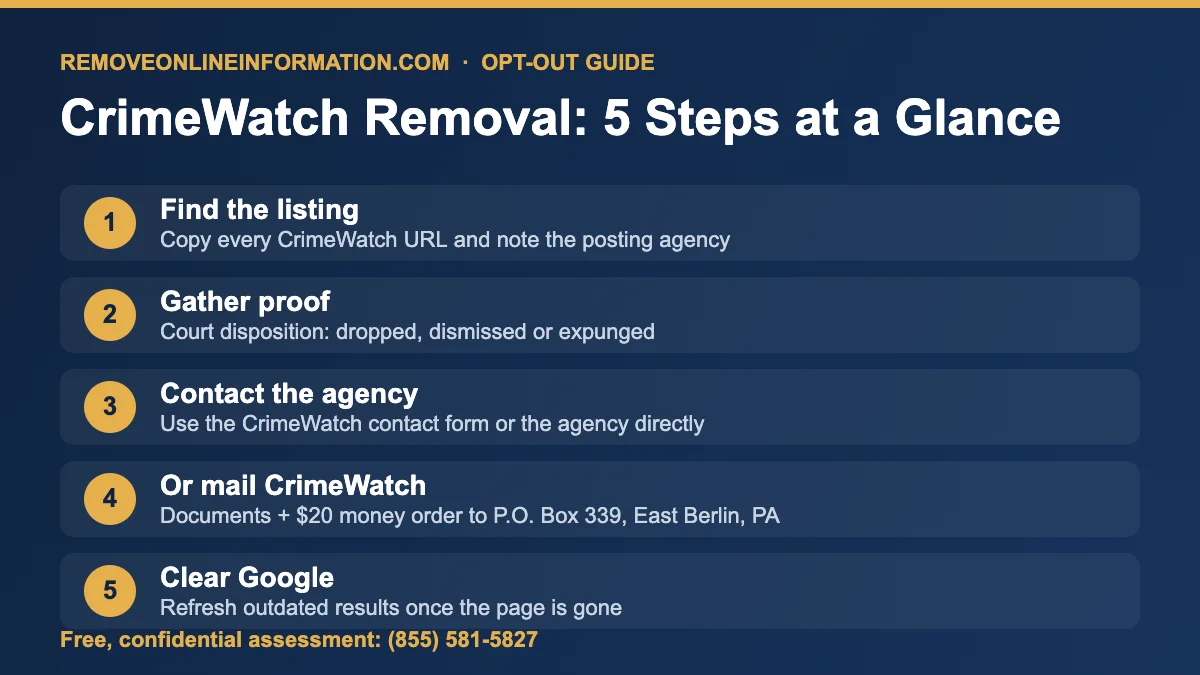
- Find every CrimeWatch post with your name. Search Google for site:crimewatch.net “Last, First” and site:crimewatch.net “First Last”, then repeat with crimewatchpa.com for older links. Agencies sometimes post a follow-up, a wanted notice and the arrest separately, so list each URL and note the agency name shown at the top of each page.
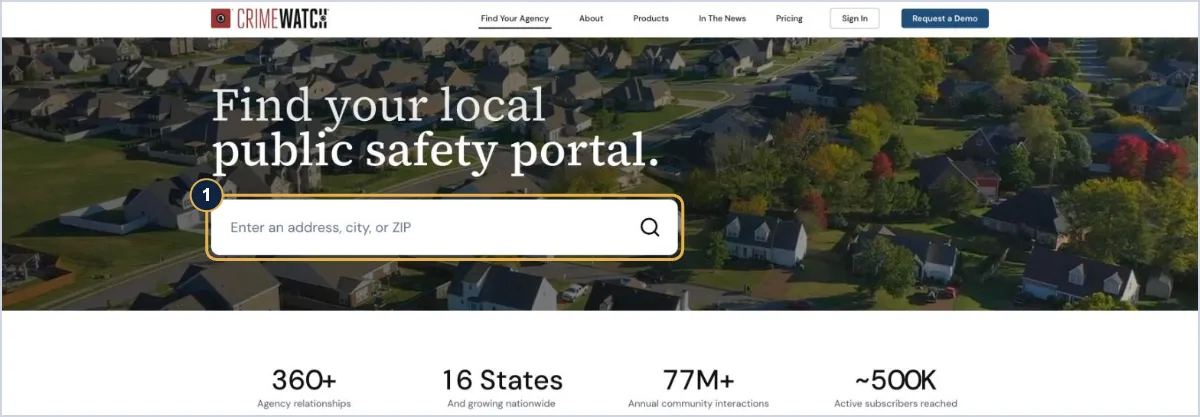
- Identify the posting agency. The agency’s name, address and phone appear in the portal header. You can also search for the town on the CrimeWatch homepage under Find your local public safety portal.
- Gather your court paperwork. CrimeWatch asks for a copy of your case disposition showing the charges were dropped, dismissed or expunged, and proof you completed your adjudication, such as time served or warrants cleared. Download the docket or disposition from your state court portal (in Pennsylvania, the UJS Portal) or request a certified copy from the clerk of courts. If your record was expunged or sealed, include the order.
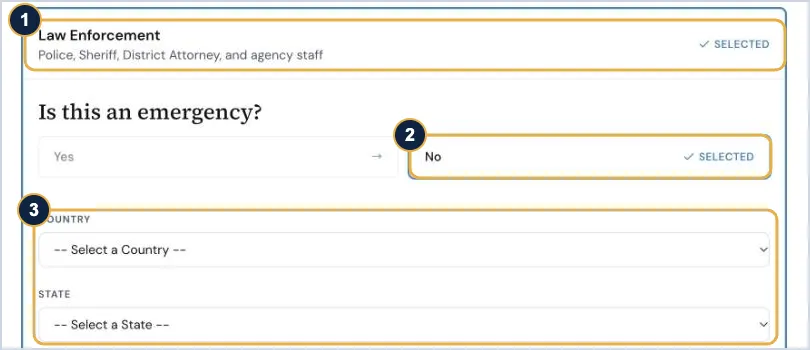
- Open the CrimeWatch contact form. Go to crimewatch.net/contact-us, choose Law Enforcement, answer No to the emergency question, then select the country, state and agency that posted your listing. That sends your message to the agency, not to CrimeWatch.
- Write a short, specific request. Give the exact URL, your name as listed, the arrest date, the outcome of the case and the docket number. Attach or offer to send the disposition. Ask for removal of the post, including the photo, rather than an edit.
- If the form will not load, contact the agency directly. When we tested the form in November 2026, the state list did not load. Use the phone number or Contact page on the agency’s own CrimeWatch portal, or call the department’s records unit, and ask who handles CrimeWatch removal requests.
- Or use the mail-in route to CrimeWatch. Mail your contact information (address, phone, email), the disposition, proof of completed adjudication and a $20 non-refundable money order payable to CRIMEWATCH Technologies, Inc. to CRIMEWATCH Technologies, P.O. Box 339, East Berlin, PA 17316. CrimeWatch says staff will review it, notify you of the decision and that processing can take up to three weeks.
- One request per post, tracked. If you have several posts, list every URL in each request and keep copies of what you sent, the date, and the money order receipt. Follow up with the agency if you hear nothing within a few weeks.
- Clear Google and Bing. When the page returns an error or no longer shows your information, use Google’s Refresh Outdated Content tool and Bing’s Content Removal tool so the old snippet and title disappear from search results.
Stuck on any step? Get a free, confidential assessment and a firm quote before any work starts: request an assessment or call (855) 581-5827.
What to write in your CrimeWatch removal request
The person reading your request is usually a records clerk, a sergeant or a CrimeWatch staff member balancing privacy against public safety. Make the decision easy: state the outcome, prove it, and keep it short. These are the grounds that tend to carry the most weight.
Charges dropped, withdrawn or dismissed
This is the case CrimeWatch names directly. Attach the disposition or docket sheet that shows each charge as withdrawn, nolle prossed or dismissed, and point out that the post still lists charges that no longer stand.
Record expunged or sealed
Include the expungement or sealing order. In Pennsylvania, Clean Slate can limit public access to some records automatically, so a printout showing limited access helps. Explain that the court has removed or restricted the record and ask the agency to bring its website in line.
Found not guilty or acquitted
A verdict sheet or disposition showing not guilty is strong evidence. Note that the post describes an accusation the court rejected.
Diversion completed (ARD or similar)
If you finished a diversion program such as Pennsylvania’s ARD, send proof of completion and, where it applies, the expungement order that often follows.
Wrong person or wrong details
If the post names you by mistake or lists the wrong charge, say exactly what is wrong and provide ID or court records that show it. A clear, documented error is often easier to get fixed than a request to remove an accurate post.
Old case, sentence completed
If you were convicted, you can still ask. Show the sentence is complete and explain the concrete harm, such as lost jobs or housing, in a sentence or two. This is a request for discretion, so be polite and factual.
Sample request
Subject: Removal request, CrimeWatch arrest post for [Full Name]
Hello, I am writing to request removal of the following post on your CrimeWatch page: [full URL], published on or about [date]. The charges listed were [dismissed/withdrawn/expunged] on [date] in [court], docket number [number]. A copy of the disposition is attached, along with proof that the case is fully closed. Because the post continues to appear in search results for my name and describes charges that no longer stand, I respectfully ask that the post and booking photo be removed. Please let me know if you need anything else. Thank you, [Name], [phone], [email].
Removal vs. de-indexing vs. sealing vs. suppression
People often mix these up. Only one of them takes the CrimeWatch page down, and only one changes your official record.
| Option | What it does | Who does it | Effect on CrimeWatch |
|---|---|---|---|
| Removal from CrimeWatch | Deletes the arrest post and photo from the agency portal | Posting agency, or CrimeWatch staff after review | Page is gone at the source |
| Search de-indexing | Drops the outdated page or snippet from Google or Bing results | Google or Bing, after you request it | Only after the page is removed or changed |
| Expungement or sealing | Clears or restricts the official court record | A court, through a petition or automatic law | None by itself, but it is your best evidence for removal |
| Suppression | Pushes the result down with positive content about you | You or a reputation firm | Post stays live, just harder to find |
| Correction | Fixes wrong details in the post | Posting agency | Post stays up with accurate information |
The best order is usually: get the court outcome on paper, request removal from CrimeWatch, then clear the search engines. If you want help with the court side, see our public records removal guide and the Remove Court Records guides on getting case pages off legal data sites.
Remove the CrimeWatch result from Google
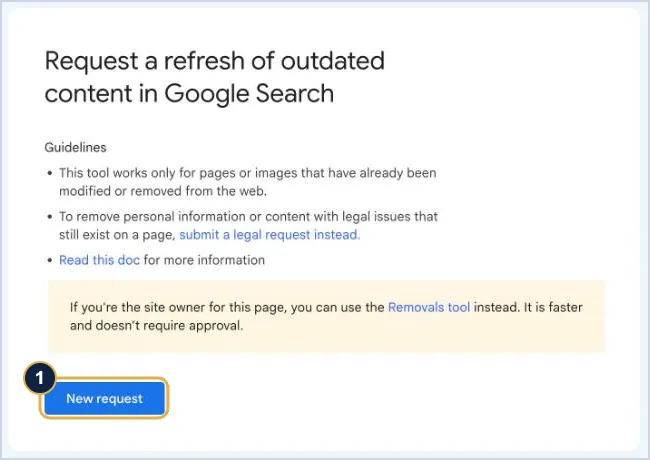
Google does not remove a live CrimeWatch arrest post just because you ask; its personal information removal policy is aimed at things like doxxing and financial or ID numbers, not official police posts. The search route works after the source changes. Once the post is deleted, confirm the URL shows an error or a page without your details, then submit it in Google’s Refresh Outdated Content tool. If the agency only removed the photo or edited the text, submit it anyway so Google refreshes the snippet. Do the same in Bing Webmaster Tools’ Content Removal tool.
Because CrimeWatch arrest pages carry a noimageindex tag, the booking photo should not be indexed from CrimeWatch on its own. If your photo still shows in Google Images, it probably came from a copy on another site, which needs its own request.
What about AI answers?
AI search tools such as Google’s AI Overviews, ChatGPT search, Perplexity and Copilot pull from the live web and their search indexes. CrimeWatch does not publish anything about how its posts are used by AI tools, and none of them offer a special removal form for police posts. In practice, once the CrimeWatch page is gone and the search engines have refreshed it, AI answers that relied on it stop citing it as fresh results replace it. Copies on aggregator sites can keep feeding AI answers, so clean those up too.
To check, ask an AI tool about your full name plus your town and see which sources it cites. If it still links to CrimeWatch after removal, submit the URL to Google and Bing again and use the tool’s own feedback option on the answer. For more on the copies that typically follow a police post, see our LocalCrimeNews removal guide and our news article removal page for local stories based on the same press release.
How long CrimeWatch removal takes
| Stage | Timeline | Source |
|---|---|---|
| Agency reviews a contact form request | Not published; varies by agency | Case by case |
| CrimeWatch reviews a mailed request | Up to three weeks for processing | CrimeWatch compliance page |
| You are told the decision | CrimeWatch says you will be notified; method not stated | CrimeWatch compliance page |
| Cases with an active investigation, current arrest or warrant | May be delayed | CrimeWatch compliance page |
| Google drops the result after removal | Typically a few days to a few weeks after a refresh request | Typical, not guaranteed |
| Copies on other sites | Separate requests, separate timelines | Each site’s own policy |
Mail adds its own time, so send the packet with tracking. If you use the agency route and hear nothing in two to three weeks, call the department’s records unit and ask for the status by reference ID, which appears on the post.
If your request is denied
- Ask what would change the decision. Some agencies will remove a post once a case is expunged, even if they declined after a dismissal.
- Request a correction instead. If the post is wrong or incomplete, ask the agency to update it with the outcome, such as charges withdrawn.
- Pursue expungement or sealing, then reapply with the order. That is the strongest evidence CrimeWatch lists.
- Use the other route. If the agency did not respond, try the mail-in review with CrimeWatch, or the reverse.
- Ask a criminal defense or expungement attorney whether your state has rules that apply to how agencies publish arrest information.
- Work on search results: suppress the page with accurate, positive content while you wait.
Why CrimeWatch requests stall
- The request went to CrimeWatch support instead of the agency that controls the post.
- No disposition was attached, so staff could not confirm the case outcome.
- The money order was missing or made out to the wrong payee for the mail-in route.
- The case is still open, a warrant is active, or there is a related investigation.
- Only one URL was listed when the agency posted several items about the same arrest.
- The contact form failed to load and the message never sent.
- The post was removed, but Google still shows the old title, so it looks like nothing happened.
Want someone to run this for you? Get a free, confidential assessment and a firm quote before any work starts.
Do it yourself or have RemoveOnlineInformation.com handle it

Many people can handle a single CrimeWatch post on their own, especially with a clean dismissal on paper. It gets harder when there are several posts, the agency is slow to answer, the case outcome is mixed, or the arrest has already spread to other sites. Pennsylvania police posts, for example, are often repeated by local outlets; our Montgomery County Police Reporter removal guide covers one of them, and our Busted Newspaper removal guide and RecentlyBooked removal guide cover common mugshot aggregators.
| Do it yourself | RemoveOnlineInformation.com | |
|---|---|---|
| Cost | Free by agency route; $20 money order by mail, plus court copy fees | Free assessment, firm quote before any work |
| Finding every post and copy | You search CrimeWatch, Google and aggregator sites | We search CrimeWatch, CrimeWatchPA links, search engines and copies |
| Preparing the request | You gather the disposition and write the letter | We prepare a documented request for each post |
| Agency follow-up | You call and email the records unit | We follow up and track each URL |
| Google and Bing cleanup | You file refresh requests | We file and monitor them |
| Other sites with the same arrest | Separate DIY requests | Handled in the same plan where possible |
For arrests that appear on police blotters and mugshot sites as well as CrimeWatch, Remove-Arrests.org offers a police blotter removal service, and MugshotRemoval.ai has a free mugshot removal request tool that drafts a request for each site. Defamation Defenders also runs a mugshot removal service.
Want your CrimeWatch listing handled? Get a free, confidential assessment and a firm quote before any work starts.
or call (855) 581-5827
CrimeWatch removal FAQ
Get your CrimeWatch arrest post handled
We find every CrimeWatch and CrimeWatchPA post with your name, the copies on other sites and the search results that show them, then prepare and follow up on each removal request. You get a free, confidential assessment and a firm quote before any work.
RemoveOnlineInformation.com is not a law firm and this page is not legal advice. We are not affiliated with CrimeWatch, CRIMEWATCH Technologies, Inc. or any law enforcement agency. Removing a website listing does not alter official arrest or court records. CrimeWatch policy details are as published on its compliance and contact pages as of November 2026 and may change.